









It's a question we hear regularly at Frank Nutt: "I'm thinking about a Juki — where do I even start?" And it's a fair one. Juki has built a reputation unlike almost any other brand in the domestic sewing machine market, and their range — while not vast — covers some genuinely distinctive ground. Understanding what makes Juki different, and what each machine in the lineup is actually designed for, makes the decision considerably easier.
This guide is here to help you do exactly that.
Why Juki?
Juki is, at its core, an industrial sewing machine manufacturer. They've been making commercial and industrial machines since 1938, and that engineering heritage flows directly into their domestic range. When Juki talks about "industrial technology for the home market," they mean it — the box feed system that sits at the heart of most of their machines is borrowed directly from their industrial line.
That matters because the feed mechanism is one of the most important factors in stitch quality. Most domestic machines use a conventional oval feed dog motion. Juki's box feed moves the feed dog in a true box motion — up, forward, down, back — which eliminates fabric shrinking and shifting and gives you far more consistent stitch quality across different fabric weights. If you've ever struggled with puckering on fine fabric, or with heavy fabric refusing to feed smoothly, this is the technology that addresses it.
There's also an honesty to the Juki range that we appreciate here. They don't try to be everything to everyone. The range is focused, purposeful, and built to a high standard. Each model has a clear place in the lineup.
What Are You Looking to Sew?
As with any machine purchase, this is the most important question to start with — and it shapes everything else.
General dressmaking and everyday sewing If you want a reliable, capable everyday machine that handles a wide variety of fabrics without complaint, the HZL-G Series is the natural starting point. The box feed system makes these machines unusually capable across fabric weights, and the wide sewing space — more than most competitors in this price range — makes working with larger projects more comfortable.

Quilting and patchwork Quilters are, in many ways, the sewing community most likely to have already heard of Juki. The brand has a strong following in the quilting world precisely because of its feeding consistency and the wide arm space. The HZL-DX Series and the TL-2200QVP Mini are both particularly well regarded here. The TL-2200QVP Mini has a working area of up to 23 inches with the auxiliary table attached, which gives you genuine room to manoeuvre a large quilt.
Heavy fabrics and specialist work If you regularly sew denim, canvas, leather, or heavy upholstery fabrics, Juki's industrial feeding power is a real asset. The TL2300 Heavy Duty, for instance, is built specifically for demanding materials. This isn't a machine you buy for delicate dressmaking — it's a machine for people who need genuine, repeatable power.
Those who want the best of everything If budget isn't the primary constraint and you want a top-specification computerised machine for all types of sewing — with every Juki refinement built in — the HZL-UX8 sits at the summit of the domestic range. It's a machine for serious, experienced sewists who want no compromises.
Understanding the Juki Range at Frank Nutt
We stock a focused selection of Juki machines, and it's worth understanding what each one brings to the table.
The G120 is an excellent all-rounder and a natural entry point into the Juki domestic range. It features the box feed system, powerful feeding that handles up to 12 layers of denim, 180 stitch patterns including one alphabet font, an automatic needle threader, and a drop-in bobbin. The sewing space is generous, and it comes with a hard carrying case. For someone stepping up from a basic machine and wanting noticeably better stitch quality and fabric handling, the G120 is a compelling option.
It carries a 2-year parts and labour guarantee when bought from Frank Nutt.
The G220 builds on the G120 with additional stitch patterns and features, sitting in the same G Series family. If you find yourself between the two and wanting a little more from the outset, it's worth comparing the stitch counts and features carefully — give us a call and we'll walk you through the differences.
Juki HZL-DX3 — £1,345
The DX3 is where Juki's Exceed Series begins, and it represents a meaningful step up. This is a high-quality computerised machine with 155 sewing patterns and 3 fonts (upper and lower case), a straight stitch slide plate for improved precision, and a heel-activated automatic thread cutter via the foot controller. The buttonhole system is automatic with a sensor and a clamping plate — important for fine fabrics and multiple layers. The DX3 is aimed at confident sewists who want professional results and appreciate the finer details.
It has a maximum sewing speed of 900 stitches per minute and comes with a 2-year guarantee.
Juki HZL-DX5 — £1,495
The DX5 continues the Exceed Series with additional features and refinements. It's built for sewists who want more — more patterns, more control, more professional finishing capability. If you're comparing the DX3 and DX5, the honest answer is to think about how often you'll push the machine's capabilities: the DX5 is designed for people who will.
At the top of the Exceed Series, the DX7 is a thoroughly capable machine for advanced sewists. It has an extended feature set and is designed for those who sew regularly across a wide range of projects and want everything to work exactly as it should, without limitation.
Juki TL-2200QVP Mini — £1,695
This is a different kind of machine entirely, and worth understanding on its own terms. The TL-2200QVP Mini is a straight-stitch-only tabletop machine — it doesn't do decorative stitches, embroidery, or even zigzag. What it does, it does exceptionally well.
Built with an aluminium die-cast frame (borrowing directly from industrial construction), it runs at up to 1,500 stitches per minute and can handle large quilts comfortably, with a work area extending to 23 inches with the auxiliary table. The knee lifter lets you raise the presser foot without using your hands — essential when you're guiding a large quilt. The foot controller doubles as a thread trimmer. And the sub tension unit ensures smooth, twist-free thread delivery even at high speeds.
If you're a dedicated quilter who wants a machine that thinks of nothing else, this is the one to look at seriously.
Juki TL2300 Heavy Duty — £1,795
The TL2300 is built for heavy work. If your sewing regularly involves multiple layers, thick materials, or demanding fabrics that other machines struggle with, this is the machine Juki designed for the job. It has the feeding power and construction quality to handle material that would cause lesser machines to labour.
Juki HZL-NX7 — £2,995
The NX7 is a high-specification computerised machine with an impressive feature set for the advanced sewer. If you're looking at this end of the Juki range, we'd always recommend coming in to the shop or giving us a ring — machines at this level are best understood when you can sit down with them.
Juki HZL-UX8 — £3,795
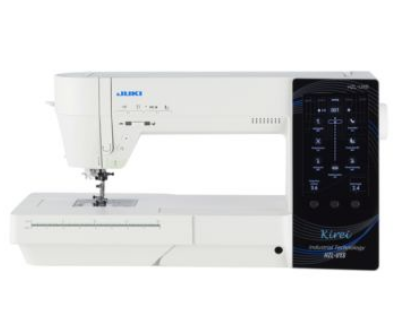
The UX8 Sits at the Very Top of the Juki Domestic Range
The UX8 sits at the very top of the Juki domestic range. It's a machine for serious sewists who want the best Juki makes, and it carries a feature set and build quality to match. If this is the machine you're considering, we'd love to show it to you in store.
The Features That Actually Matter
Juki machines come with a handful of features worth understanding properly, because they're not just marketing terms — they make a practical difference.
Box Feed System
This is the most important Juki technology to understand, and we've covered it above. If stitch consistency and smooth fabric feeding matter to you — and they should — the box feed is why Juki stands out from the crowd. It's present across the domestic range.
Automatic Thread Trimmer (Heel-Activated)
On the Exceed Series (DX3 and above), pressing the heel of the foot controller automatically trims both the top and bottom threads simultaneously. It's the kind of feature that sounds like a luxury until you've used it — then it becomes difficult to sew without it.
Straight Stitch Slide Plate
Present on the DX Series, this replaces the standard throat plate with a straight-stitch-only version, giving the needle a much tighter hole to work with. The result is cleaner, more precise straight stitching — particularly noticeable on fine or silky fabrics that would otherwise be drawn down into a wider needle hole.
Float Function
The float function raises the presser foot slightly off the fabric surface, allowing the material to move freely without drag. It's particularly useful when doing free motion work or quilting.
Automatic Needle Threader
Present across the range. It works consistently and saves considerable time — worth more than it might sound after the hundredth bobbin change.
Industrial-Quality Buttonholes
Juki's automatic 1-step buttonhole system, with its built-in clamping plate, holds fine fabrics and multiple layers firmly during buttonhole sewing. The result is a noticeably more professional finish than you'll get from many domestic machines.
What's Your Budget?
Juki machines at Frank Nutt start from £949 with the HZL-G120, and move through to £3,795 for the HZL-UX8. The TL-2200QVP Mini sits at £1,695 and represents a very different kind of value — specialist performance at a competitive price.As a general rule with Juki: the machines are well built throughout the range, and you'll notice the difference between price points because each step up brings genuine capability rather than just extra features on paper. That said, the right machine is the one that suits what you actually sew — not the most expensive one we stock. We've been helping people find that balance since 1985.
Our After-Sales Support
All Juki machines bought from Frank Nutt come with a 2-year parts and labour guarantee. We're also an authorised Juki dealer, which matters when it comes to parts, servicing, and any warranty work.We service and repair machines in-house, and our team knows these machines well. If you ever have a question after your machine arrives, you can ring us on 0121 444 3978 and speak to someone who can actually help.
Still Not Sure?
That's completely fine — and it's exactly what we're here for. We have over 80 machines on display at our shop in Kings Heath, Birmingham. You're welcome to sit down with the Juki machines we stock, try them on real fabric, and talk things through with the team.