









What to Know Before Choosing a Singer Sewing Machine
Singer is one of those brands that almost everyone has heard of. It's been making sewing machines since 1851, and the name carries a weight of recognition that few others in any industry can match. But familiarity can sometimes make a decision feel easier than it is — and when people come into Frank Nutt asking about Singer, one of the most common things we hear is: "I know I want a Singer, I'm just not sure which one."
It's a good place to be, actually. The Singer range at Frank Nutt covers a meaningful spread of machines, from straightforward mechanical models for beginners right through to computerised machines with large stitch libraries. If you take a little time to understand the range before you buy, you're far more likely to end up with a machine that suits you properly — rather than one that either leaves you frustrated or one you outgrow in a few months.
This guide covers the key things worth knowing before you choose a Singer sewing machine.
Why Singer?
Singer's longevity isn't just a marketing story. The brand has survived — and remained relevant — because it makes accessible, dependable sewing machines that do what they're supposed to do without unnecessary complexity. The machines we stock at Frank Nutt are well-built, widely supported, and easy to find parts and accessories for.
Singer is also one of the more honest brands in the industry when it comes to positioning. Their entry-level machines are genuinely entry-level — they don't pretend to be more than they are. Their heavier-duty machines are built to handle more demanding work. And the computerised models offer a real step up in capability without requiring you to become a tech expert to operate them.
Browse our full range of Singer sewing machines here.
Step one: Be honest about what you'll actually sew
This question matters more than any spec on a machine, and it's worth sitting with for a moment before you look at models.
Occasional sewing — repairs, simple projects, getting started
If you're new to sewing, returning after a long break, or mainly planning to use a machine for repairs and straightforward alterations, you don't need a lot of machine. The Singer Tradition series — the 2259, 2263, and 2273 — covers this ground very well. These are mechanical machines with a clear, no-fuss approach to sewing. There's no screen, no computer, and no unnecessary features to navigate around. You select your stitch with a dial, set your tension, and sew. For a lot of people, that's exactly what they want.
The Simple 3223 sits in a similar space — as the name suggests, it's designed to be approachable rather than feature-heavy, with 23 built-in stitches and a straightforward layout that makes it easy to pick up.

Regular sewing — garments, home furnishings, growing your skills
If you're sewing more regularly and want a machine that keeps pace with your projects, the Singer Talent 3321 and the Confidence 7463 are worth a closer look. The Talent has 21 built-in stitches and an automatic needle threader, and it's a reliable everyday machine for dressmaking and general projects. The Confidence 7463 steps things up with 30 built-in stitches, a top-drop-in bobbin, and an automatic one-step buttonhole — it's a comfortable machine for someone who sews regularly and wants more than the basics without a steep learning curve.
Heavy fabrics — denim, canvas, upholstery, multiple layers
This is where Singer's Heavy Duty range comes into its own. The Heavy Duty 4411 and 4423 are machines with a reinforced metal frame, a more powerful motor, and a higher stitching speed than the standard Singer machines. They handle thick fabrics, multiple layers, and heavier thread without the hesitation or struggling that a standard machine can show in those situations.
The 4423 in particular is a machine that gets recommended often for people who work with denim, leather, canvas, or soft furnishing fabrics. It has 23 stitches, an automatic needle threader, and a stitch speed of up to 1,100 stitches per minute — which is noticeably faster than most machines in this price range.
If you do a mix of light and heavy work, the Heavy Duty machines handle lighter fabrics perfectly well too. They're not single-purpose machines — the "heavy duty" label refers to their capability ceiling, not a limitation on what they'll accept.
More ambitious sewing — large stitch libraries, computerised features
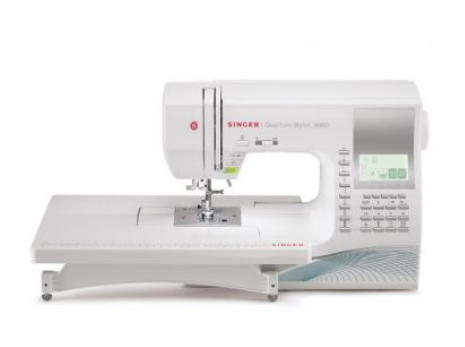
If you sew varied projects and want access to a wide range of stitches, the Singer Confidence 7470 and the Quantum Stylist 9960 represent the upper end of the Singer range at Frank Nutt. The Confidence 7470 has 70 built-in stitches including a selection of decorative options, and an LCD display for stitch selection. The Quantum Stylist 9960 is the most capable Singer we stock — 600 stitches, an automatic needle threader, five presser feet included, and a level of versatility that suits an experienced sewist who wants genuine variety in what their machine can do.
Step two: Mechanical or computerised?
This is one of the first questions worth settling, because it shapes which part of the Singer range you're choosing from.
Mechanical machines use dials and levers for everything — stitch selection, stitch length, stitch width, tension. There's no screen, no memory, and no software. What this means in practice is that they're very simple to use, very easy to service, and very reliable over time. There are fewer things that can go wrong, and when something does need attention, it's usually straightforward to address.
The Singer Tradition and Simple models are all mechanical. If you value simplicity and don't foresee needing a large stitch library, a mechanical machine is often the right answer — and it's worth being honest with yourself about whether you'll genuinely use the features a computerised machine offers before paying more for them.
Computerised machines use electronic controls and typically an LCD or digital display for stitch selection. Stitch length and width can often be adjusted digitally, and many offer features like automatic one-step buttonholes that read the button size and replicate it precisely, memory functions for saving settings, and a much larger selection of stitches. The Singer Confidence 7470 and Quantum Stylist 9960 are computerised machines.
The honest answer is that most sewists — including experienced ones — use a relatively small number of stitches regularly. A straight stitch, a zigzag, an overcast stitch, and a buttonhole cover the majority of everyday sewing. A large stitch count is genuinely useful if you do decorative work, but if you don't, it's not something you'll miss.
Step three: The features that make a real difference
Rather than working through every specification, here are the features that genuinely affect what it's like to sew on a Singer machine day to day.
Automatic needle threader
Threading a needle by hand becomes tedious very quickly, and it's particularly difficult in poor light or for anyone with limited close-up vision. Most Singer machines above the entry level include an automatic needle threader, and it's one of those features that sounds minor until you've relied on it for a few months.
Singer machines use a top-drop-in bobbin on most of their range — you load the bobbin from the top, under a clear plastic cover, and the threading path is easy to follow. This is notably more convenient than the front-loading bobbin system found on some other brands, and it makes changing thread much quicker.
Automatic buttonhole
Entry-level Singer machines use a four-step buttonhole, which requires you to manually change the stitch setting at each stage of the buttonhole process. Mid-range and above machines offer an automatic one-step buttonhole, which is considerably easier — you lower the foot, set the length, and the machine does the rest. If you make garments regularly, the difference in time and consistency is meaningful.
Stitch speed and motor power
The standard Singer machines run at a maximum of around 750 stitches per minute, which is perfectly adequate for most sewing. The Heavy Duty 4411 and 4423 run faster — up to 1,100 stitches per minute — and use a more powerful motor. If you work with thick fabrics, upholstery, or denim, this matters. If you don't, it's a feature you'll rarely notice.
Free-arm
All the Singer machines we stock at Frank Nutt include a free-arm — the cylindrical area that becomes accessible when you remove the accessory tray. This is essential for sewing cuffs, sleeve hems, trouser legs, and children's clothing, and it's a feature worth confirming before buying any machine.
Presser feet included
Singer machines come with a selection of presser feet in the box, and the specific feet vary by model. The Quantum Stylist 9960 includes five presser feet, which is notably generous and adds real immediate versatility. On the simpler models, the standard kit is more basic, but Singer accessories are widely available and reasonably priced.
Step four: What about budget?
Singer sewing machines at Frank Nutt start from £189 and run to £799 for the Quantum Stylist 9960. It's a sensible spread for the range Singer occupies — accessible without being disposable.
The honest advice we give everyone is to buy the right machine for what you actually want to do, not the cheapest one you can justify. A machine that frustrates you, or that you outgrow before you've had it a year, isn't good value regardless of what it cost. At the same time, if you're genuinely uncertain about how much you'll sew, starting in the middle of the range is often wiser than committing to the top.
If you're also considering machines from other brands, our Pfaff sewing machines offer a different approach to engineering quality — particularly through the IDT™ integrated dual feed system — and may be worth comparing depending on what you're planning to make.
One thing Singer does particularly well
It's worth mentioning that Singer's brand recognition means their machines hold their value reasonably well, and — importantly — consumables and accessories are easy to find. Singer bobbins, feet, and needles are widely stocked, which matters over the life of a machine. It's a practical consideration that often gets overlooked when people are comparing specifications.
Our after-sales support
All Singer machines bought from Frank Nutt are backed by our in-house servicing capability. We've been servicing sewing machines since 1985, and we can work on Singer machines across the range. If you have a question after your machine arrives, you can call us on 0121 444 3978 and speak to someone who actually knows what they're talking about.
Still not sure?
That's fine — and it's exactly why we keep over 100 machines on display at our shop in Kings Heath, Birmingham. If you're unsure between two models, coming in and trying them both with real fabric is by far the best way to decide. We're always happy to talk it through and help you find what suits you.
Browse the full Singer sewing machine range at Frank Nutt, or give us a call on 0121 444 3978 and we'll point you in the right direction.